
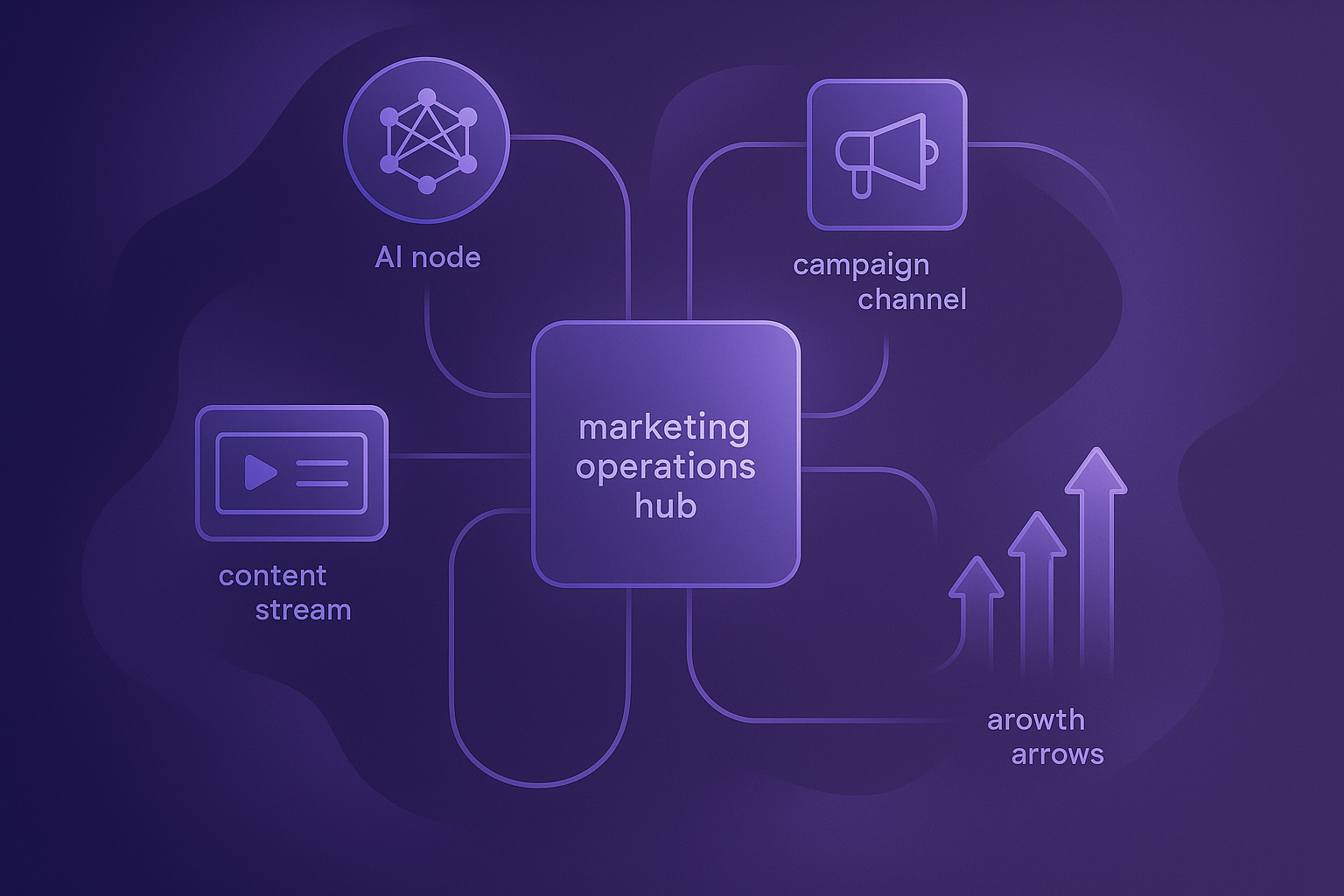
Accelerating Content Velocity with Agentic Marketing Infrastructure: A Growth Migration Guide
Teams should migrate to agentic marketing infrastructure in phases: audit current content and growth workflows, define governed knowledge and signal sources, pilot governed marketing AI agents with human review, connect a shared intelligence layer, expand into cross-channel growth execution, and validate measurement, ownership, rollback, and executive outcome alignment before scaling.
Content velocity is no longer just a content production problem. Enterprise marketing teams can generate more drafts, variants, briefs, and campaign ideas than ever, but output alone does not create a durable growth system. Velocity becomes useful when content is grounded in approved brand knowledge, informed by customer and channel signals, routed through the right review workflows, activated across channels, and measured against business priorities.
This guide outlines a practical migration path for mid-market and enterprise organizations moving from fragmented content operations to governed agentic marketing infrastructure. It is written for marketing, growth, analytics, lifecycle, content, paid media, SEO, AEO/GEO, and leadership teams that need faster execution without losing control of brand, measurement, or operational governance.
Why Content Velocity Requires an Infrastructure Migration, Not More Standalone Generation
Many content operations hit the same ceiling: teams add more writers, more AI drafting tools, more campaign calendars, or more channel-specific workflows, but the system still feels slow. The bottleneck is rarely only drafting. It is usually the infrastructure around the draft.
Content velocity depends on several connected operating layers:
- Clear briefs that reflect current customer, audience, product, and market context
- Approved positioning, proof points, brand rules, and channel constraints
- Performance history from content, paid media, lifecycle campaigns, SEO, and AEO/GEO activity
- Human review paths based on content risk, audience sensitivity, and channel impact
- Cross-channel coordination so content is not created in isolation from activation
- Executive reporting that connects execution volume to measurable operating priorities
Standalone generation tools can help create raw output, but they often leave the harder coordination problems unresolved. If every team still has its own brief format, data view, approval path, campaign calendar, and reporting method, higher content volume can create more review burden and more inconsistency.
Agentic marketing infrastructure is different from simply adding another writing assistant. It introduces governed agents, shared knowledge, connected signals, and execution workflows that help teams move from isolated production to coordinated growth operations. The goal is not to remove marketing judgment. The goal is to make that judgment easier to apply consistently across more campaigns, surfaces, and markets.
FlickBloom is enterprise marketing AI infrastructure for organizations that need growth systems to be faster, more measurable, and more governed. FlickBloom adds the agent layer on top of an enterprise marketing stack rather than replacing every existing tool, connecting customer data, brand knowledge, content production, paid media, SEO, AEO/GEO, lifecycle execution, and executive reporting into one operating layer.
Assess the Current State of Content, Channel, Data, and Approval Workflows
A migration should begin with an honest current-state assessment. Before introducing agentic workflows, teams need to know where the existing system is fragmented, where approvals slow down execution, and where data is not trusted enough to support better decisions.
Start by mapping how content moves today from idea to measurement. For each major content or campaign workflow, document:
- Who requests the work and how priorities are set
- What data informs the brief
- Which brand, product, legal, regional, or channel rules apply
- Who reviews drafts and who has final decision rights
- How content is adapted for paid media, SEO, AEO/GEO, lifecycle, social, or sales journeys
- Where performance is measured and how learnings return to the next cycle
This assessment should include both visible workflow issues and quieter operating risks. Common risk areas include data quality problems, outdated brand guidance, duplicate content efforts, approval bottlenecks, inconsistent channel adaptation, weak measurement handoffs, and over-automation pressure. If these issues are not addressed before migration, agents may accelerate the same fragmentation that already exists.
A useful assessment also separates workflows by risk level. A low-risk content refresh may require a lighter review path than a major product launch page, paid acquisition campaign, executive thought leadership piece, or lifecycle message tied to retention or expansion. Risk-based workflow design helps teams move faster where they can while maintaining review discipline where it matters most.
At this stage, the need for a governed operating layer often becomes clear. FlickBloom is especially relevant when marketing, lifecycle, content, paid media, analytics, growth, and leadership teams are working from fragmented tools and need more coordinated execution across channels and reporting layers.
Build the Approved Knowledge Base and Shared Intelligence Layer
Once the current state is mapped, the next migration step is to define the knowledge and signal foundation agents are allowed to use. This is where content velocity becomes more governed: teams establish what the system should know, what it should reference, and where human review remains required.
A governed knowledge base should include the durable context that content and campaign workflows rely on every day:
- Approved brand positioning, voice, messaging, and proof points
- Product facts, audience definitions, sales journey context, and common objections
- Channel rules for paid media, SEO, AEO/GEO, lifecycle, social, and executive communications
- Content structures, reusable brief patterns, and quality expectations
- Review workflows and escalation paths for higher-risk work
- Entity definitions that help make brand and product knowledge machine-readable
The point is not to freeze knowledge. The point is to make the source of truth explicit, reviewable, and reusable. Without this layer, every campaign risks starting from a new blank document, a local folder, a past Slack thread, or a channel-specific interpretation of the brand.
FlickBloom’s Governed Knowledge Layer captures approved brand context, performance history, channel rules, review workflows, positioning, proof points, content structure, and entity definitions. For content velocity, that matters because agent-assisted work should start from institutional learning rather than isolated briefs.
The second foundation is signal intelligence. A shared intelligence layer connects customer, campaign, creative, audience, channel, revenue, lifecycle, and AI discovery signals so teams can see how execution patterns relate to market behavior and business priorities. Instead of treating content production, paid media, lifecycle campaigns, SEO, and AEO/GEO as separate reporting worlds, teams can use shared signal context to decide what to create, update, test, promote, or retire.
FlickBloom’s Enterprise Signal Intelligence supports this layer by connecting creative, audience, channel, revenue, lifecycle, and AI discovery signals. In a migration, this helps teams move from content calendars built mainly around requests to workflows informed by customer behavior, channel performance, search demand, discovery visibility, and executive priorities.
Pilot Governed Marketing AI Agents with Human Review, Escalation, and Rollback Paths
The pilot phase should be narrow enough to control and meaningful enough to reveal how the new operating model works. A good pilot does not attempt to migrate every workflow at once. It chooses a defined use case, sets review rules, identifies owners, and establishes rollback criteria before agents assist with execution.
Examples of pilot workflows include:
- Refreshing a cluster of SEO and AEO/GEO resource pages using approved entity definitions and review workflows
- Turning performance learnings from paid media into new content briefs and landing page variants
- Repurposing high-performing content into lifecycle campaign assets with channel-specific constraints
- Creating a governed campaign planning workflow that connects audience signals, content recommendations, and executive reporting
Governed marketing AI agents should operate inside clear boundaries. Before a pilot begins, teams should define what agents can draft, recommend, summarize, route, or optimize; what requires human review; and what should be escalated. Review depth should vary by content risk, channel impact, and business sensitivity.
A practical pilot plan should answer four questions:
- Who owns the workflow? Assign business ownership, content ownership, data ownership, and final approval authority.
- What knowledge can agents use? Limit agent context to approved brand, product, performance, channel, and audience inputs.
- Where does review happen? Define review checkpoints for briefs, drafts, channel adaptation, launch readiness, and measurement.
- When do teams pause or roll back? Set criteria for reverting to the prior process, narrowing the pilot, or reworking agent instructions.
Rollback planning is not a sign of failure. It is part of responsible migration. Teams should know how to pause an agent-assisted workflow, revert to a previously accepted version, remove a workflow from the pilot, or require additional review if brand quality, data reliability, approval confidence, or channel consistency falls below expectations.
FlickBloom supports governed marketing AI agents as part of a broader infrastructure layer. In this migration model, agents work with approved knowledge, signal context, and human review rather than operating as unsupervised campaign owners. That governance-first approach is essential when content velocity must scale across multiple teams, markets, brands, or channels.
Expand into Cross-Channel Growth Execution and AI Discovery Visibility
After a governed pilot is working, the next step is expansion into cross-channel growth execution. This is where content velocity becomes more than publishing more assets. It becomes a coordinated system for creating, adapting, activating, and learning across the channels that shape acquisition, engagement, retention, and market visibility.
Cross-channel expansion should happen in stages. A team might begin with content and SEO workflows, then connect paid media learnings, then add lifecycle campaign adaptation, then expand into AEO/GEO visibility and executive reporting. The right sequence depends on where the organization has the strongest data, clearest ownership, and highest operational readiness.
A cross-channel workflow might look like this:
- Enterprise Signal Intelligence identifies an audience shift, content gap, campaign learning, or AI discovery visibility change.
- The Governed Knowledge Layer supplies approved positioning, channel rules, proof points, and entity definitions.
- Governed marketing AI agents assist with briefs, content variants, lifecycle messages, SEO updates, AEO/GEO structure, or paid media concepts.
- Human reviewers evaluate brand quality, channel fit, business sensitivity, and launch readiness.
- The Execution and Optimization Layer helps coordinate activation and learning across content, paid media, SEO, AEO/GEO, lifecycle execution, and executive reporting.
AI discovery visibility deserves specific attention during migration. Search behavior is expanding beyond traditional search results into AI-native answer engines and AI-assisted discovery experiences. For AEO/GEO work, teams should focus on structured content, clear entity definitions, consistent brand and product information, and visibility tracking across relevant surfaces.
FlickBloom supports AI discovery visibility through structured content, entity definitions, and visibility tracking across ChatGPT, Perplexity, Claude, and Google AI Overviews. This work should be treated as an ongoing visibility and knowledge management discipline, not as a shortcut. Structured content and entity clarity can support discoverability, but teams should still monitor outcomes and adjust based on what the market and channels show.
Validate Measurement, Ownership, and Executive Outcome Alignment Before Scaling
Before scaling agentic marketing infrastructure, teams should validate whether the new operating model is improving coordination, governance, and decision quality. Measurement should include operational indicators as well as business-facing indicators, because content velocity is useful only when it helps the organization act with more clarity.
Useful validation areas include:
- Content velocity: Are briefs, drafts, reviews, adaptations, and updates moving through the system with fewer avoidable delays?
- Governance quality: Are agents using the right knowledge, following channel rules, and routing work through the right review paths?
- Cross-channel coordination: Are content, paid media, SEO, AEO/GEO, lifecycle, and reporting workflows becoming more connected?
- AI discovery visibility: Are structured content, entity definitions, and visibility tracking being maintained as part of the workflow?
- Acquisition efficiency signals: Are teams better able to evaluate campaign learnings, audience signals, and budget allocation opportunities?
- Executive outcome alignment: Can leadership see how execution connects to priorities such as content velocity, market expansion, AI visibility, lifecycle performance, and measurable growth operations?
Ownership matters as much as measurement. Agentic infrastructure changes how work moves between teams, so scaling requires clear roles. Marketing leaders should own growth priorities and brand direction. Content leaders should own editorial quality and content systems. Analytics leaders should own measurement logic and signal interpretation. Channel owners should define execution constraints and performance learnings. Executive stakeholders should align the operating model with business priorities and governance expectations.
This is also the point to assess adoption. Teams may need new working rhythms, clearer intake processes, updated review policies, and training on how to use agents responsibly. Adoption should not be evaluated only by tool usage. It should be evaluated by whether teams are making better coordinated decisions, reducing avoidable handoffs, and keeping execution aligned with governance.
FlickBloom connects content production, lifecycle execution, AEO/GEO, and executive reporting as part of its governed operating layer. As organizations scale the migration, this supports executive outcome alignment by connecting day-to-day execution with measurable operating priorities such as acquisition efficiency, content velocity, AI visibility, and sustainable market expansion.
Where FlickBloom Fits in a Governed Agentic Marketing Infrastructure Migration
FlickBloom supports organizations that need content velocity to operate as part of a governed growth system rather than a disconnected production sprint. FlickBloom Marketing AI Agent Infrastructure connects customer data, brand knowledge, content production, paid media, SEO, AEO/GEO, lifecycle execution, and executive reporting into one operating layer.
The platform is designed to add a governed agent layer on top of the existing enterprise marketing stack. That distinction matters for migration planning. Most organizations do not want to replace every tool, process, or team at once. They need an infrastructure layer that can connect knowledge, signals, execution, and reporting while preserving human review and governance.
In a migration, FlickBloom’s product layers map to the core operating needs:
- FlickBloom Marketing AI Agent Infrastructure provides the governed agent layer for coordinating marketing decisions across channels, accelerating content velocity, improving AI visibility workflows, and connecting execution to leadership priorities.
- Enterprise Signal Intelligence supports the shared intelligence layer for customer, campaign, creative, audience, channel, revenue, lifecycle, and AI discovery signals.
- Governed Knowledge Layer keeps approved brand context, performance history, channel rules, review workflows, content structure, and machine-readable entity knowledge available to agent-assisted workflows.
- Execution and Optimization Layer supports coordinated activation across content, paid media, SEO, AEO/GEO, lifecycle execution, and executive reporting.
To determine whether FlickBloom is the right fit, consider practical questions:
- Is the current marketing stack fragmented enough that a shared operating layer would improve coordination?
- Are there enough customer, campaign, content, channel, and lifecycle signals to support smarter execution?
- Is the organization ready to define approved knowledge, review workflows, and ownership before scaling agents?
- Does leadership need clearer reporting across acquisition efficiency, content velocity, AI discovery visibility, and growth operations?
- Can the migration begin with a focused pilot before expanding into broader cross-channel execution?
FlickBloom gives marketing, growth, analytics, and leadership teams a governed system for improving acquisition efficiency, AI visibility, content velocity, and sustainable market expansion. For teams planning a migration, the right starting point is not a full-scale rollout. It is a focused assessment of workflows, signals, governance readiness, and executive priorities.
Contact FlickBloom to discuss how governed marketing AI agents, AI discovery visibility, and enterprise growth infrastructure can support your migration.

