
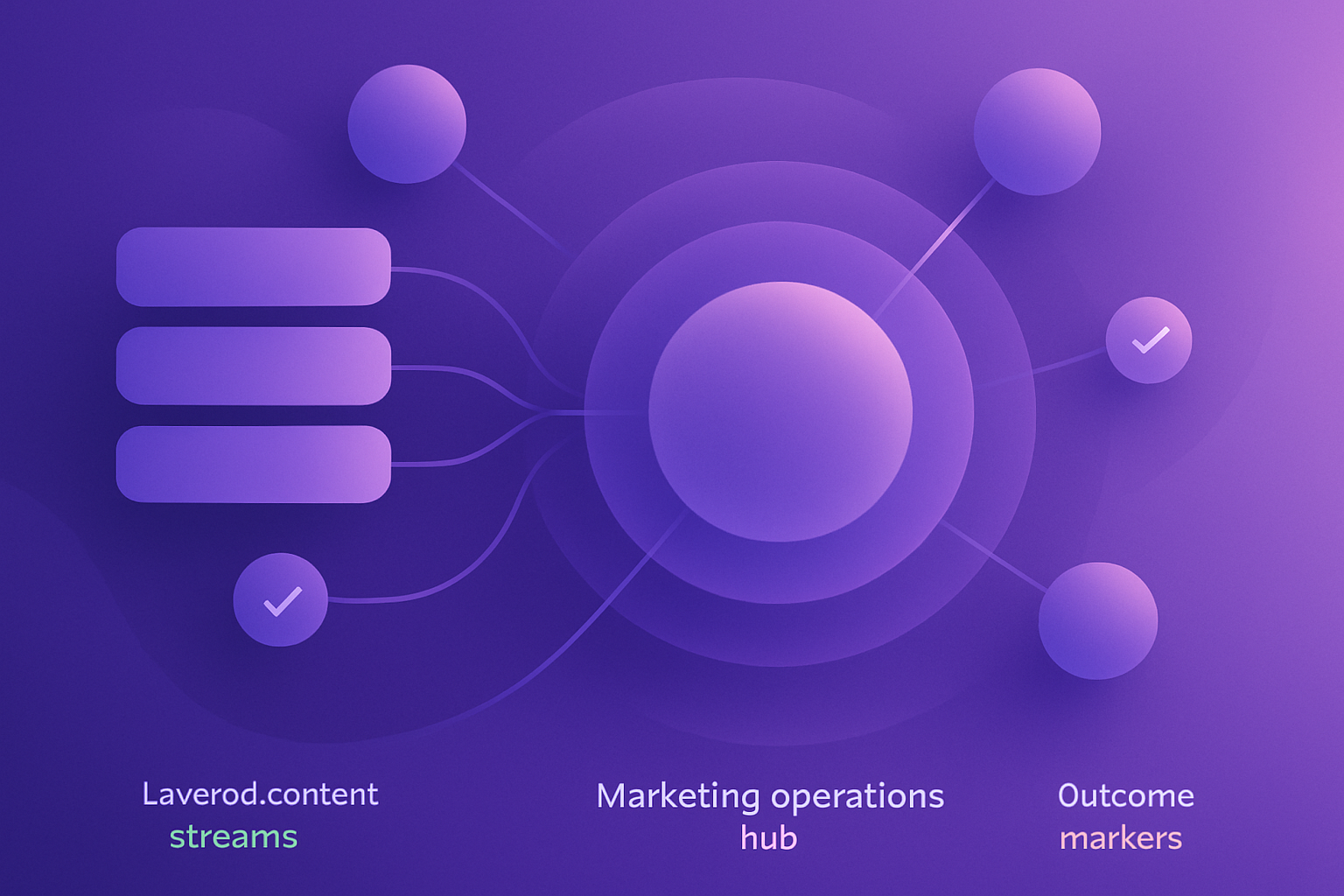
Accelerating Content Velocity with Agentic Marketing Infrastructure for Lifecycle Measurement and Outcomes Guide
Teams should measure content velocity by looking beyond asset volume: track how quickly lifecycle work moves from planning to production, review, activation, learning, and iteration, then connect that speed to governance quality, lifecycle coverage, channel performance signals, AI discovery visibility, and executive outcome alignment. The strongest evidence model combines workflow timestamps, approval records, content inventory data, campaign analytics, lifecycle journey metrics, experiment logs, search and answer-engine visibility tracking, and executive dashboards so leaders can decide when to scale, revise, pause, or investigate.
FlickBloom is enterprise marketing AI infrastructure for organizations that need growth systems to be faster, more measurable, and more governed. For lifecycle content velocity, FlickBloom connects customer data, brand knowledge, content production, paid media, SEO, AEO/GEO, lifecycle execution, and executive reporting into one operating layer, adding the agent layer on top of an enterprise marketing stack rather than replacing every existing tool.
What content velocity means across the lifecycle
Content velocity in a lifecycle context means the rate at which useful, approved, measurable content moves through the full journey system. It is not simply a count of briefs written, pages published, emails drafted, ads produced, or social assets created.
A lifecycle velocity model should include:
- Planning speed: how quickly teams identify journey gaps, audience needs, channel opportunities, and business priorities.
- Production throughput: how many usable assets, variants, or journey components move from brief to draft.
- Review latency: how long content waits for brand, legal, product, analytics, or channel review.
- Activation coverage: whether approved assets actually reach paid media, lifecycle campaigns, SEO, content hubs, AEO/GEO structures, and other relevant surfaces.
- Learning cadence: how quickly performance signals are interpreted and turned into the next brief, test, update, or journey adjustment.
- Reuse and modularity: whether content components can be adapted across segments, funnel stages, regions, campaigns, and answer-engine contexts without restarting the workflow each time.
This matters because lifecycle programs often fail to accelerate when teams only optimize one step. A content team may draft faster, but if approvals stall, journey logic is unclear, channel handoffs are manual, or reporting is disconnected, the business does not experience real lifecycle acceleration. Content velocity should therefore measure end-to-end movement through the operating system.
FlickBloom Marketing AI Agent Infrastructure is designed for this connected view. It brings customer data, brand knowledge, content production, paid media, SEO, AEO/GEO, lifecycle execution, and executive reporting into one governed operating layer so teams can evaluate velocity as a workflow, not as isolated content output.
Why agentic marketing infrastructure changes the measurement model
Agentic marketing infrastructure changes measurement because it connects the work, signals, rules, and reporting that are often spread across disconnected marketing tools. Instead of asking only, “How much content did we produce?” teams can ask, “Did faster content movement improve lifecycle coverage, preserve review quality, support cross-channel activation, and create clearer decision signals?”
A point solution may speed up one task: drafting a subject line, generating a landing page outline, summarizing search intent, or producing creative variants. Agentic marketing infrastructure is different because it coordinates across the operating layer. For FlickBloom, that layer includes customer data, approved brand context, content workflows, lifecycle execution, paid media, SEO, AEO/GEO, AI discovery visibility, and executive reporting.
That changes measurement in four ways:
- Speed becomes contextual. Faster production is useful only when assets are approved, activated, and measured in the right lifecycle moments.
- Governance becomes measurable. Review workflows, approved brand context, channel constraints, and exception handling become part of the evidence model.
- Signals become shared. Enterprise Signal Intelligence provides a shared intelligence layer for creative, audience, channel, revenue, lifecycle, and AI discovery signals, helping teams interpret performance patterns together rather than in separate reporting silos.
- Executive reporting becomes part of the workflow. Leaders can evaluate whether velocity is improving planning, activation, learning, and business-facing decision clarity.
The goal is not to make content production look faster in isolation. The goal is to create a governed system where speed, quality, channel execution, lifecycle progression, and leadership reporting can be reviewed together.
Outcome categories that show whether velocity is improving responsibly
Responsible content velocity measurement separates activity from quality, lifecycle movement, channel performance, AI visibility, and executive relevance. A useful measurement model should include categories that show whether work is accelerating in a controlled and commercially meaningful way.
| Measurement category | What to measure | Why it matters |
|---|---|---|
| Activity and throughput | Briefs created, drafts produced, assets approved, variants generated, updates shipped | Shows whether the workflow is moving, but should not be treated as sufficient evidence by itself |
| Cycle time and review latency | Time from request to brief, draft to review, review to approval, approval to activation | Identifies bottlenecks that slow lifecycle programs even when production volume rises |
| Quality and governance | Approval completion, revision reasons, brand consistency checks, channel-rule adherence, exception routing | Confirms that acceleration is happening within governed workflows |
| Content reuse and modularity | Reused components, adapted proof points, journey modules, refreshed assets, localization or segment variants where relevant | Shows whether teams are building reusable lifecycle infrastructure rather than one-off assets |
| Lifecycle coverage | Journey stages supported, audience segments covered, nurture paths updated, onboarding or retention touchpoints improved | Connects content velocity to the customer journey instead of isolated publishing |
| Cross-channel activation | Paid media, lifecycle campaigns, SEO, content, AEO/GEO, and other channel deployments | Shows whether approved work is reaching the channels where it can be tested and learned from |
| Channel performance signals | Engagement, conversion progression, search demand, campaign response, creative test results, lifecycle behavior | Provides directional evidence on whether faster activation is producing useful market feedback |
| AI discovery visibility | Structured content coverage, entity definitions, machine-readable brand knowledge, answer-engine visibility tracking | Measures whether content is becoming more interpretable for AI-assisted discovery environments |
| Executive reporting adoption | Dashboard usage, decision meetings, budget discussions, priority changes, documented next actions | Shows whether measurement is helping leadership make clearer decisions |
FlickBloom supports this connected measurement model through three complementary layers. Enterprise Signal Intelligence helps interpret creative, audience, channel, revenue, lifecycle, and AI discovery signals together. The Governed Knowledge Layer captures approved brand context, performance history, channel rules, review workflows, content structure, and entity definitions. The Execution and Optimization Layer supports coordinated activation across paid media, lifecycle campaigns, SEO, content, and answer-engine visibility.
These categories should be treated as measurement lenses, not promises of a specific commercial result. The practical question is whether the operating system gives teams better evidence for deciding what to scale, revise, retire, or investigate.
Evidence sources teams should trust before making decisions
The best evidence for lifecycle content velocity comes from systems and records that show how work moved, who reviewed it, where it was activated, what signals came back, and how leaders used those signals. Reliable evidence is usually multi-source, timestamped, and tied to a defined workflow.
Teams should prioritize evidence such as:
- Workflow timestamps: request dates, brief creation dates, draft completion dates, review start and end dates, approval dates, and activation dates.
- Content inventory data: asset type, journey stage, target audience, channel destination, reuse status, refresh history, and owner.
- Approval records: review participants, comments, revision reasons, exception notes, and final approval status.
- Campaign and channel analytics: paid media results, lifecycle campaign engagement, SEO performance, content engagement, and creative test signals.
- Lifecycle journey analytics: progression between stages, nurture engagement, onboarding behavior, retention indicators, and segment-level movement where available.
- CRM or revenue-system indicators where available: opportunity progression, pipeline influence, retention signals, payback or LTV context, and other leadership-relevant indicators that are interpreted with appropriate assumptions.
- Search and answer-engine visibility tracking: structured content coverage, entity consistency, query visibility, answer-engine monitoring, and AI discovery visibility patterns.
- Experiment logs: hypotheses, variants, audience definitions, date ranges, decision criteria, and final interpretation.
- Executive dashboards: the reporting layer that connects operational movement to leadership decisions.
Weak evidence usually appears when teams rely only on raw AI output counts, vanity engagement metrics, isolated asset volume, or last-click-only interpretation. Those signals can be useful inputs, but they should not carry the entire decision. A lifecycle velocity program needs evidence that connects speed, governance, activation, learning, and business relevance.
FlickBloom brings multiple signal types into a shared intelligence layer so marketing, growth, analytics, lifecycle, content, paid media, SEO, AEO/GEO, and leadership stakeholders can work from a more connected view of what changed and where to act next.
How governed marketing AI agents accelerate work without removing review
Governed marketing AI agents should be measured as workflow accelerators operating inside approved brand context, channel constraints, review workflows, and human oversight. They are most useful when they reduce friction around planning, drafting, structuring, routing, activation support, and learning loops while keeping accountable teams in control of final decisions.
In a lifecycle content workflow, governed marketing AI agents can support tasks such as:
- turning customer, channel, search, and lifecycle signals into brief recommendations;
- drafting content variants based on approved positioning and journey context;
- structuring content for SEO and AEO/GEO readability;
- suggesting lifecycle journey gaps or refresh opportunities;
- preparing creative testing options for paid media and lifecycle programs;
- routing work through review workflows based on risk, channel, or policy;
- summarizing performance patterns for analytics and leadership review.
The measurement question is not whether an agent produced more drafts. The question is whether agent-assisted work moved through the lifecycle faster while preserving review quality, brand consistency, channel fit, and decision clarity.
FlickBloom’s Governed Knowledge Layer supports this model by organizing approved brand context, performance history, channel rules, review workflows, machine-readable entity knowledge, positioning, proof points, and content structure. That knowledge layer helps agent-assisted workflows begin from institutional context rather than disconnected prompts.
Governance should remain visible in reporting. Teams should track how often agent-assisted work required revision, which review steps created delays, what types of assets needed escalation, and whether approved content was activated across the intended lifecycle and channel surfaces.
Connecting cross-channel growth execution to executive outcome alignment
Content velocity creates strategic value when it supports cross-channel growth execution and executive outcome alignment. Lifecycle content does not live in one channel. A single insight may need to inform paid media creative, nurture sequences, SEO pages, sales enablement, onboarding messages, retention programs, and answer-engine content structures.
That is why velocity measurement should connect activation and performance signals across:
- lifecycle campaigns and journey stages;
- paid media creative and audience tests;
- SEO and content performance;
- AEO/GEO readiness and AI discovery visibility;
- customer behavior and engagement signals;
- budget allocation discussions;
- executive reporting and decision meetings.
FlickBloom connects cross-channel growth execution signals to executive reporting through a governed operating layer. Enterprise Signal Intelligence interprets creative, audience, channel, revenue, lifecycle, and AI discovery signals together, while the Execution and Optimization Layer supports coordinated activation across paid media, lifecycle campaigns, SEO, content, and answer-engine visibility.
For executives, the useful output is not a larger reporting deck. It is a clearer view of tradeoffs. Faster content velocity should be evaluated alongside acquisition efficiency, engagement, conversion progression, retention indicators, budget allocation signals, pipeline influence where appropriate, AI discovery visibility, and reporting clarity. Those are measurable outcome areas that help leadership decide where to invest attention, resources, and review cycles.
Teams should be careful not to overstate causality. Cross-channel measurement often contains directional signals, lagging indicators, and shared influence across touchpoints. Executive reporting should document assumptions, comparison periods, and confidence levels so decisions are grounded in evidence rather than narrative momentum.
A baseline-to-decision framework for lifecycle content velocity
A practical measurement framework starts before the first agent-assisted workflow is scaled. Teams need a baseline, a target workflow, evidence instrumentation, comparison logic, and decision thresholds.
Use this baseline-to-decision framework:
- Baseline the current workflow. Measure current cycle time from request to brief, draft, review, approval, activation, and reporting. Identify where work stalls and where evidence is missing.
- Map the lifecycle use cases. Define which journeys, stages, segments, channels, and content types are in scope. Examples may include onboarding, nurture, expansion, retention, reactivation, or product education programs.
- Define the governed agent role. Clarify which tasks agents support, which tasks require human review, which assets need escalation, and which approval paths apply.
- Instrument trusted evidence sources. Connect workflow timestamps, content inventory, approval records, campaign analytics, lifecycle metrics, AI discovery visibility tracking, experiment logs, and executive dashboards.
- Compare periods or cohorts carefully. Use before-and-after comparisons, journey cohorts, or campaign groups where appropriate, and document seasonality, budget shifts, audience changes, and channel changes.
- Separate activity from outcomes. More drafts, more variants, or more published assets should be reviewed alongside governance quality, lifecycle coverage, channel activation, and executive decision usefulness.
- Set decision thresholds. Decide in advance what evidence will trigger scaling, revision, pausing, or investigation. Thresholds should reflect workflow maturity, risk tolerance, channel importance, and leadership priorities.
- Review assumptions with stakeholders. Bring marketing, growth, analytics, lifecycle, content, paid media, SEO, AEO/GEO, and leadership perspectives into the interpretation process.
FlickBloom can support this framework by connecting the signal, knowledge, execution, AI discovery, and reporting layers needed for lifecycle velocity measurement. FlickBloom supports AEO/GEO through structured content, entity definitions, machine-readable brand knowledge, and visibility tracking across AI-assisted discovery environments.
The most useful decision thresholds are specific to the organization. For example, a team may choose to scale a workflow when cycle time improves and approval quality remains stable, revise when output increases but activation coverage does not, pause when review exceptions rise, or investigate when channel signals diverge from lifecycle behavior. The key is to make the decision rule explicit before interpreting the results.
FAQ
What outcomes should teams measure when accelerating content velocity with agentic marketing infrastructure?
Teams should measure production throughput, cycle time, review latency, content reuse, lifecycle journey coverage, activation coverage, personalization readiness, creative testing cadence, channel performance signals, AI discovery visibility, governance adherence, and executive reporting adoption. Business-facing measurement can include acquisition efficiency, engagement, conversion progression, retention indicators, budget allocation signals, pipeline influence where appropriate, and reporting clarity.
What evidence is most useful for lifecycle content velocity decisions?
Useful evidence includes workflow timestamps, content inventory data, approval records, campaign analytics, lifecycle journey metrics, CRM or revenue-system indicators where available, experiment logs, search and answer-engine visibility tracking, and executive dashboards. The evidence should show how work moved, where it was reviewed, where it was activated, what signals returned, and how decisions changed.
How should teams measure governed marketing AI agents?
Measure governed marketing AI agents by their impact on reviewable workflows: time saved in planning or drafting, review latency, revision reasons, approval completion, channel-rule adherence, activation coverage, and learning cadence. Agent work should be evaluated inside approved brand context, channel constraints, review workflows, and human oversight.
How does AI discovery visibility fit into content velocity measurement?
AI discovery visibility should be measured through structured content, entity definitions, machine-readable brand knowledge, answer-engine visibility tracking, and the consistency of brand information across relevant discovery surfaces. It should not be treated as an assumed outcome of publishing more content.
How does FlickBloom support this measurement model?
FlickBloom Marketing AI Agent Infrastructure connects customer data, brand knowledge, content production, paid media, SEO, AEO/GEO, lifecycle execution, and executive reporting into one governed operating layer. Enterprise Signal Intelligence provides a shared intelligence layer for creative, audience, channel, revenue, lifecycle, and AI discovery signals, while the Governed Knowledge Layer supports approved brand context, channel rules, review workflows, content structure, and entity definitions.
What weak evidence should teams avoid overvaluing?
Teams should avoid relying on raw AI output counts, isolated asset volume, vanity engagement metrics, or last-click-only interpretation as the sole proof of lifecycle impact. Those inputs may have supporting value, but responsible measurement should connect speed, governance quality, activation, lifecycle movement, channel signals, AI discovery visibility, and executive decision-making.
Next Step
Contact FlickBloom to discuss governed marketing AI agents, AI discovery visibility, and enterprise growth infrastructure.

