
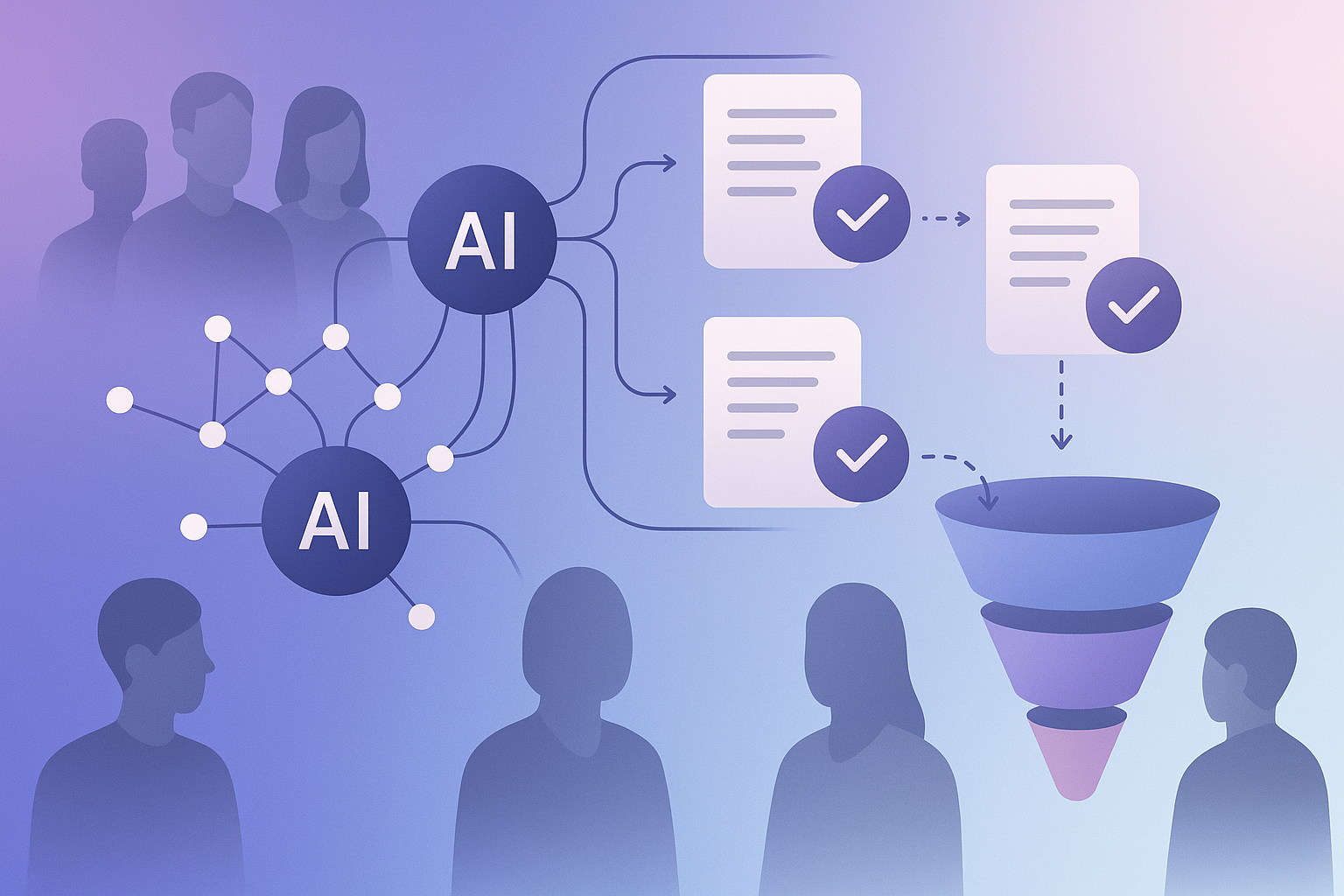
Troubleshooting Content Velocity With Governed Marketing AI Agents for Lifecycle Teams
Teams should diagnose lifecycle content velocity problems by tracing the slowdown across goals, signals, knowledge, workflow ownership, review paths, channel constraints, reporting, and executive outcome alignment—not by assuming the AI agent itself is the only issue. If governed marketing AI agents are not increasing content velocity, the root cause is often an operating-model gap: unclear lifecycle use cases, fragmented customer and campaign signals, incomplete brand knowledge, overloaded approvals, disconnected reporting, or weak validation after content is shipped.
Start with the symptom: where lifecycle content velocity is breaking
Before changing prompts, switching tools, or expanding agent access, isolate where the lifecycle content process is actually slowing down. Content velocity is not just draft generation speed. For lifecycle teams, it includes the time and quality required to move from audience signal to brief, draft, review, channel adaptation, launch, measurement, and reuse.
A healthy AI-assisted lifecycle workflow should make it easier to produce governed variants for welcome flows, nurture streams, onboarding sequences, retention programs, reactivation campaigns, customer education, event follow-up, and expansion journeys. If the team is generating more drafts but still cannot launch better lifecycle programs, the bottleneck is likely outside the draft step.
Common symptoms: slow approvals, duplicated work, off-brand drafts, and stalled personalization
Common symptoms include:
- Slow approvals: Drafts are created quickly, but legal, brand, product, lifecycle, or executive reviews still take too long.
- Duplicated work: Multiple teams brief similar nurture, onboarding, or retention content without shared visibility into what already exists.
- Off-brand drafts: Agent outputs require heavy rewriting because the system lacks current positioning, proof points, audience definitions, or tone rules.
- Stalled personalization: Teams want journey-stage or segment-specific variants, but customer signals and personalization rules are not connected to the workflow.
- Channel rework: Email, paid media, landing page, SEO, and AEO/GEO versions are created separately, causing inconsistent messaging.
- Reporting gaps: Teams cannot connect faster content production to measurable lifecycle indicators such as engagement quality, conversion movement, retention signals, customer education completion, or executive priorities.
The practical troubleshooting question is: where does content stop moving? If ideas move slowly into briefs, diagnose strategy and signals. If drafts move slowly into review, diagnose ownership and approval paths. If approved assets do not launch consistently across channels, diagnose execution constraints. If launch happens but learnings do not improve the next cycle, diagnose reporting and feedback loops.
How to separate agent output problems from workflow, data, and governance problems
A useful first pass is to separate the issue into four categories:
| Symptom | Likely root cause | What to inspect first |
|---|---|---|
| Drafts are generic | Missing lifecycle goals, audience definitions, or brand context | Journey-stage map, segment definitions, proof points, messaging rules |
| Drafts are accurate but slow to launch | Review bottlenecks or unclear ownership | Approval paths, escalation rules, risk tiers, reviewers by content type |
| Content launches but variants are inconsistent | Channel rules are disconnected | Email constraints, paid media rules, landing page standards, SEO and AEO/GEO structure |
| Team cannot prove progress | Reporting is not tied to outcomes | Lifecycle dashboards, content velocity measures, engagement and retention indicators |
Agent output issues are real, but they are often downstream of missing inputs. A lifecycle AI agent cannot reliably adapt messaging for a retention trigger if the trigger is undefined, if the customer signal is not accessible, or if the approved knowledge base does not include current product and brand context.
This is where FlickBloom’s operating-layer approach is designed to help. FlickBloom Marketing AI Agent Infrastructure adds a governed agent layer on top of the existing enterprise marketing stack rather than replacing every tool. It connects customer data, brand knowledge, content production, paid media, SEO, AEO/GEO, lifecycle execution, and executive reporting into one operating layer so teams can diagnose content velocity as a system-level workflow rather than a single prompt problem.
Diagnose root causes across lifecycle goals, customer signals, brand knowledge, and ownership
Once the symptom is clear, diagnose the root cause. Lifecycle content velocity depends on whether the agent has clear objectives, trusted inputs, defined constraints, and a path to activation with human review.
Unclear lifecycle goals and journey-stage definitions
AI agents underperform when the lifecycle goal is vague. “Create more nurture content” is not specific enough. The agent needs to understand the journey stage, audience state, desired behavior, message angle, content format, channel, and review sensitivity.
Start by asking:
- Which lifecycle stage is the workflow designed to improve: awareness-to-consideration nurture, onboarding, adoption, retention, winback, or expansion?
- What customer behavior or signal should trigger the content?
- Which segments need distinct messaging, and why?
- What content gaps slow the team today?
- Which outputs require deeper review because they involve product claims, regulated language, pricing, legal sensitivity, or executive positioning?
Remediation begins with lifecycle mapping. Define the journeys where faster content production would be most useful, then document what each journey needs: segment logic, content formats, timing, trigger rules, offer rules, proof points, and measurement signals.
Validation should not focus only on how many drafts the agent produces. Review whether the team can move a lifecycle use case from brief to reviewed content to channel-ready execution with fewer avoidable handoffs and clearer accountability.
Fragmented customer, campaign, creative, and performance signals
Lifecycle content velocity breaks when customer, campaign, creative, and performance signals live in disconnected places. An agent may create copy, but it cannot make useful recommendations if it cannot see what audiences have responded to, which creative themes are overused, where journeys are leaking, or which lifecycle triggers matter.
This is the role of a shared intelligence layer. FlickBloom’s Enterprise Signal Intelligence is built around creative, audience, channel, revenue, lifecycle, and AI discovery signals. For troubleshooting, that matters because lifecycle content decisions should not be isolated from paid media learnings, SEO demand, AEO/GEO visibility work, customer behavior, or executive reporting.
When signals are fragmented, teams commonly see:
- Repeated content ideas that do not reflect recent performance learning.
- Lifecycle messages that conflict with paid media, landing page, or sales enablement language.
- Segmentation rules that are too broad to support useful personalization.
- Retention or reactivation campaigns that are built from assumptions rather than observed customer signals.
- Content calendars that move independently from acquisition, lifecycle, and leadership priorities.
To remediate this, consolidate the signal view used for lifecycle planning. The team does not need every possible data point on day one. It needs enough shared context to answer: who is the content for, what has changed, what action should happen next, what channel constraints apply, and how will the result be reviewed?
Incomplete approved brand context or channel rules
AI-assisted lifecycle production slows down when every draft requires brand correction. That usually means the agent lacks governed knowledge: positioning, product facts, approved claims, proof points, audience definitions, tone rules, content structures, and channel-specific constraints.
FlickBloom’s Governed Knowledge Layer is designed to capture approved brand context, performance history, channel rules, review workflows, positioning, proof points, content structure, and entity definitions. For lifecycle teams, this helps turn brand knowledge into reusable operating context rather than tribal knowledge held by a few reviewers.
Troubleshoot the knowledge layer by checking:
- Does the agent know which claims are approved and which require escalation?
- Are lifecycle-specific tone differences documented for prospects, active customers, dormant users, and executive audiences?
- Are channel constraints defined for email, landing pages, paid ads, SEO pages, and AEO/GEO content?
- Are entity definitions and structured content rules available for AI discovery visibility work?
- Are review paths tied to content risk rather than treating every asset the same?
If outputs are consistently off-brand, do not start by asking the agent for “better copy.” Start by improving the knowledge foundation. The agent should be working from current, governed context and routing sensitive work through human review.
Remediate the workflow with governance, review paths, and lifecycle ownership
After diagnosis, remediation should focus on the operating model. Governed marketing AI agents work best when teams define what agents can draft, what they can recommend, what they can prepare for review, and what requires human approval before launch.
A practical remediation sequence is:
- Audit the inputs. Review lifecycle goals, customer segments, trigger rules, brand knowledge, product facts, proof points, channel constraints, and performance history.
- Map the workflow. Document how an idea becomes a brief, draft, reviewed asset, channel-ready variant, launched campaign, and learning input.
- Assign ownership. Define who owns lifecycle strategy, data signals, knowledge updates, content review, channel adaptation, campaign launch, and reporting.
- Create review tiers. Lower-risk content may need brand and lifecycle review; higher-risk content may require product, legal, compliance, or executive review.
- Instrument feedback. Capture what was approved, changed, rejected, launched, and learned so the next content cycle starts from institutional learning.
Governance should not be treated as friction added after AI generation. It is the system that makes agent-assisted production usable in a mid-market or enterprise environment. Review paths, escalation rules, and approval stages allow teams to increase throughput while keeping brand, policy, and audience context visible.
Validate whether content velocity is actually improving
Validation should combine production, quality, activation, and outcome indicators. A team can generate more content and still fail to improve lifecycle execution if approved content does not launch, if personalization remains shallow, or if leadership cannot see how the work connects to business priorities.
Useful validation questions include:
- Are briefs becoming more complete before drafting begins?
- Are reviewers seeing fewer avoidable brand, product, or channel corrections?
- Are more lifecycle journeys supported with channel-ready assets?
- Are content variants tied to clear segment or journey-stage logic?
- Are learnings from paid media, SEO, AEO/GEO, lifecycle campaigns, and customer behavior feeding the next planning cycle?
- Can leadership see how content velocity connects to measurable indicators such as acquisition efficiency, retention signals, budget allocation, customer education, AI visibility, or lifecycle engagement?
This is where executive outcome alignment matters. Content velocity should not be measured only as “more assets.” It should be connected to the operating indicators that leadership uses to understand growth system health. FlickBloom supports this by connecting day-to-day execution with executive reporting across the marketing operating layer.
Prevent recurring content velocity failure modes
Prevention requires a cadence, not a one-time fix. Lifecycle programs change as audiences shift, products evolve, channels change rules, and AI discovery surfaces interpret brand information differently.
A prevention model should include:
- Knowledge refreshes: Keep brand context, product facts, positioning, claims, proof points, content structure, and entity definitions current.
- Signal reviews: Review creative, audience, channel, revenue, lifecycle, and AI discovery signals together rather than in separate channel reports.
- Workflow retrospectives: Identify where content stalled, which reviews caused avoidable rework, and which handoffs need clearer ownership.
- Channel-rule updates: Refresh constraints for lifecycle email, paid media, landing pages, SEO, and AEO/GEO content as requirements change.
- Human review calibration: Align reviewers on what should be corrected, escalated, approved, or turned into reusable guidance.
- Executive reporting alignment: Keep content velocity connected to measurable business and marketing indicators without treating any single content output as the whole story.
For AEO/GEO and AI discovery visibility, prevention should focus on structured content, entity clarity, consistent definitions, and visibility tracking. AI agents can help prepare and maintain structured assets, but teams should still review how the brand is represented, which entities are defined, and whether content is formatted for extraction and interpretation by answer engines.
Where FlickBloom fits in a governed lifecycle AI operating model
FlickBloom is enterprise marketing AI infrastructure for organizations that need growth systems to be faster, more measurable, and more governed. For lifecycle content velocity, FlickBloom provides infrastructure for connecting the pieces that often break apart: customer data, brand knowledge, content production, paid media, SEO, AEO/GEO, lifecycle execution, and executive reporting.
The relevant FlickBloom layers for this troubleshooting use case include:
- FlickBloom Marketing AI Agent Infrastructure: A governed agent layer that helps coordinate marketing decisions across channels and connect lifecycle execution to the broader growth operating layer.
- Enterprise Signal Intelligence: A shared intelligence layer for creative, audience, channel, revenue, lifecycle, and AI discovery signals.
- Governed Knowledge Layer: A governed source of approved brand context, performance history, channel rules, review workflows, positioning, proof points, content structure, and entity definitions.
- Execution and Optimization Layer: A coordination layer for cross-channel growth execution across lifecycle campaigns, paid media, SEO, content, and answer engine visibility workflows.
FlickBloom adds the agent layer on top of an enterprise marketing stack rather than replacing every existing tool. That distinction is important for troubleshooting: if the issue is disconnected knowledge, unclear review ownership, or reporting fragmentation, the answer is not simply “more AI generation.” The answer is governed infrastructure that helps lifecycle, growth, analytics, content, paid media, SEO, AEO/GEO, and leadership stakeholders work from a shared operating layer.
FAQ
Why are AI agents not increasing lifecycle content velocity for our team?
The most common reason is that the agent is being asked to solve an operating-model problem. If lifecycle goals are unclear, customer signals are fragmented, brand context is incomplete, or approval ownership is undefined, the agent may generate drafts quickly while the total workflow still moves slowly. Diagnose the journey stage, inputs, review path, channel constraints, and reporting loop before changing the agent configuration.
What should teams check first when AI-generated lifecycle content feels generic?
Start with the knowledge foundation. Check whether the agent has current positioning, product facts, audience definitions, lifecycle stage rules, proof points, tone guidance, offer rules, and channel constraints. Generic output often means the system lacks the context needed to distinguish onboarding from retention, nurture from reactivation, or executive education from tactical campaign copy.
How should governed marketing AI agents be configured for lifecycle workflows?
Governed marketing AI agents should be configured with clear lifecycle goals, approved brand context, customer and campaign signals, channel rules, review stages, escalation paths, and measurable validation criteria. They should prepare drafts, variants, recommendations, and structured content for review while keeping human approval and governance visible in the workflow.
What role does a shared intelligence layer play in lifecycle content velocity?
A shared intelligence layer helps teams avoid producing lifecycle content from disconnected assumptions. By connecting creative, audience, channel, revenue, lifecycle, and AI discovery signals, teams can see which messages, journeys, and content gaps matter before creating more assets. FlickBloom’s Enterprise Signal Intelligence supports this kind of connected signal view.
How does AI discovery visibility connect to lifecycle content troubleshooting?
AI discovery visibility connects to lifecycle content when brand entities, product definitions, educational content, and journey-stage content need to be structured for AI answer extraction and interpretation. Troubleshooting should focus on whether content has clear entity definitions, consistent terminology, useful structure, and visibility tracking across relevant AI and search surfaces.
How should leadership evaluate whether content velocity is improving?
Leadership should evaluate content velocity through a mix of workflow and outcome indicators: brief quality, review-cycle friction, approved asset readiness, lifecycle journey coverage, channel activation, performance feedback loops, and connection to executive priorities. The goal is not simply more content; it is a governed system that helps teams connect content production to measurable growth-system signals.
Where does FlickBloom fit if we already have marketing tools in place?
FlickBloom adds a governed agent layer on top of the existing enterprise marketing stack. It is designed to connect customer data, brand knowledge, content production, paid media, SEO, AEO/GEO, lifecycle execution, and executive reporting into one operating layer so teams can reduce fragmented handoffs and improve governed cross-channel growth execution.
Next Step
Contact FlickBloom to discuss how governed marketing AI agents, AI discovery visibility, and enterprise growth infrastructure can support your lifecycle content workflows.

