
Paid Media Observability and Governance Checklist for Faster Content Velocity and AI Discovery Visibility
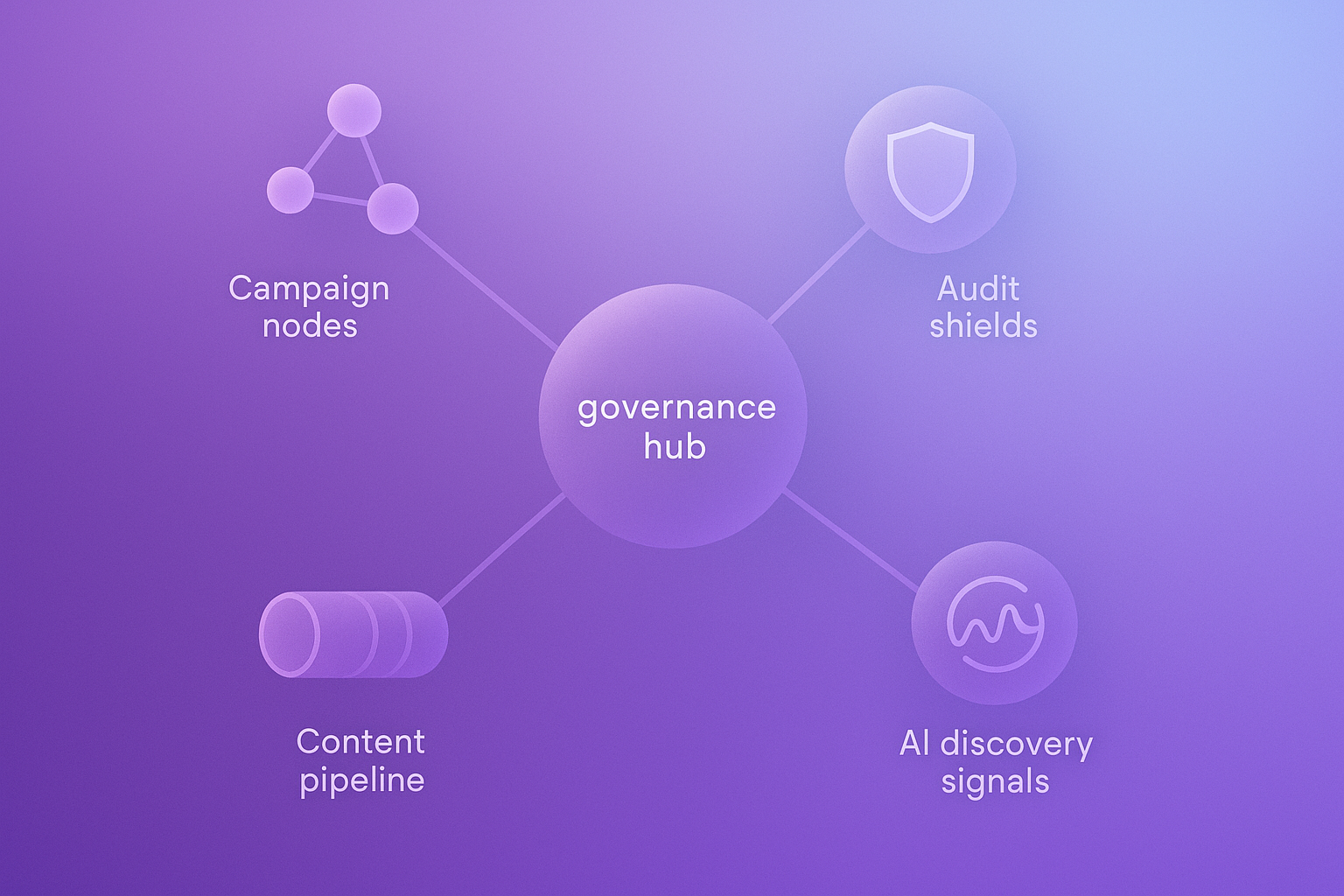
Teams using AI-assisted content velocity for paid media should monitor source inputs, creative and audience signals, landing page alignment, claims, spend exposure, channel constraints, AI discovery visibility, approval workflows, access permissions, review ownership, escalation paths, and executive outcome alignment before increasing output. The goal is not simply to produce more variants faster; it is to make faster production measurable, reviewable, and connected to how paid media, content, SEO, AEO/GEO, lifecycle execution, and leadership reporting work together.
Faster content production changes the operating model for growth teams. More briefs, more ad variants, more landing page tests, and more answer-engine-ready content can create opportunity, but they also increase the number of decisions that need context, policy, and review. A useful observability and governance checklist should help teams answer three questions: what signals are changing, who is responsible for reviewing them, and what action is allowed next.
FlickBloom is enterprise marketing AI infrastructure for organizations that need growth systems to be faster, more measurable, and more governed. FlickBloom adds the agent layer on top of an enterprise marketing stack rather than replacing every existing tool, connecting customer data, brand knowledge, content production, paid media, SEO, AEO/GEO, lifecycle execution, and executive reporting into one operating layer.
Define the Operating Goal Before Increasing Paid Media Content Output
Before increasing paid media content output, teams should define the operating goal. “More content” is not specific enough. A stronger goal connects content velocity to measurable management concerns such as acquisition efficiency, creative learning speed, message consistency, AI discovery visibility, lifecycle relevance, and executive reporting.
This is where governance begins. If teams increase asset production before defining review points, source-of-truth rules, and decision ownership, the system can become faster but harder to manage. A governed workflow should make it clear which inputs are approved, which variants require review, which changes can be tested, and which decisions need escalation.
Connect content velocity to measurable management concerns
Content velocity should be measured as part of a larger operating system, not as a standalone production metric. The most useful monitoring model connects output volume to the decisions leadership, growth, analytics, and channel teams actually need to make.
Teams should define how faster content production will be evaluated across areas such as:
- Production throughput: briefs created, variants reviewed, content refreshed, and campaigns supplied with relevant assets.
- Learning quality: which messages, audiences, offers, landing pages, and content themes are producing useful signals.
- Paid media observability: how creative changes, audience inputs, budget movement, and channel constraints relate to campaign performance signals.
- AI discovery visibility: whether structured content, entity definitions, and source consistency are improving how the brand can be understood across AI discovery surfaces.
- Executive outcome alignment: how acquisition efficiency, content velocity, AI visibility, and sustainable market expansion are reported as management concerns.
The operating goal should also define what the team will not optimize blindly. For example, a paid media team may decide that no new variant can go live unless the claim has been reviewed, the landing page message matches the ad promise, and the audience logic is understood. A content team may decide that AI discovery visibility work must align with approved entity definitions and structured content, not just keyword expansion.
Clarify where paid media, content, SEO, AEO/GEO, and lifecycle teams intersect
AI-assisted content velocity often exposes gaps between teams that previously worked in separate systems. Paid media needs fast creative testing. Content needs brand and proof-point accuracy. SEO and AEO/GEO teams need structured content, entity clarity, and visibility tracking. Lifecycle teams need message continuity after acquisition. Analytics teams need signals that can be interpreted across channels. Leadership needs a concise view of what changed and why it matters.
A governance checklist should identify the intersection points before execution accelerates:
- Brief creation: Which customer, market, performance, and brand inputs are allowed into the brief?
- Message development: Which positioning, offers, proof points, and claims are approved for paid use?
- Creative variant generation: Which variables can change, and which require human review?
- Landing page alignment: Does the page support the same promise, audience, entity, and conversion path as the ad?
- AEO/GEO readiness: Are entity definitions, structured content, and source consistency maintained when content is updated?
- Lifecycle handoff: Does the post-click or post-conversion journey continue the same narrative and audience logic?
- Executive reporting: Can leadership see how content velocity, paid media learning, and AI discovery visibility are connected?
FlickBloom supports this kind of connected operating model by bringing customer data, brand knowledge, content production, paid media, SEO, AEO/GEO, lifecycle execution, and executive reporting into one operating layer. For mid-market and enterprise teams, that connection matters because paid media decisions rarely stay inside a single channel. Creative tests influence landing pages, landing pages influence search and answer-engine content, and acquisition signals influence lifecycle strategy.
Set review points before briefs, variants, tests, and budget movement
Governed marketing AI agents should be supervised through clear review workflows, approved context, channel constraints, and escalation paths. Human review is not a late-stage formality; it should be designed into the operating rhythm before teams increase campaign and content volume.
A practical review model can include checkpoints such as:
- Input review: Confirm that customer, audience, campaign, and brand signals are appropriate for the task.
- Brief approval: Review the objective, audience, offer, channel, claims, and landing page intent.
- Variant review: Approve message, creative direction, proof points, and claims before activation.
- Landing page review: Confirm message match, entity consistency, conversion path, and source alignment.
- Campaign launch review: Check channel constraints, spend exposure, targeting logic, and measurement expectations.
- Budget-change review: Define who can approve budget movement and what signals should trigger review.
- Escalation review: Route sensitive claims, unusual performance changes, data-quality issues, or brand concerns to the right owner.
This kind of workflow helps teams move faster without losing control over brand context, factual accuracy, paid media exposure, or management reporting. The point is not to slow every action down. The point is to distinguish routine iteration from decisions that affect budget, customer experience, brand trust, or executive interpretation.
Checklist: Source Inputs, Telemetry, and the Shared Intelligence Layer
Once operating goals and review points are defined, teams need observability. Observability means understanding which inputs shaped a recommendation, which signals changed after execution, and which decisions should happen next. In paid media and AI discovery visibility workflows, that requires a shared intelligence layer rather than isolated reports.
FlickBloom’s Enterprise Signal Intelligence is a shared intelligence layer for creative, audience, channel, revenue, lifecycle, and AI discovery signals. FlickBloom’s Governed Knowledge Layer captures approved brand context, performance history, channel rules, review workflows, positioning, proof points, content structure, and entity definitions. Together with the Execution and Optimization Layer, FlickBloom supports cross-channel growth execution across paid media, lifecycle campaigns, SEO, content, and answer-engine visibility.
Customer, audience, creative, campaign, lifecycle, and revenue signals
A paid media observability checklist should start with source inputs. If the inputs are unclear, the outputs become difficult to trust, compare, or govern.
Teams should monitor whether each AI-assisted brief, content asset, or campaign recommendation is grounded in the right signal categories:
- Customer signals: audience segments, customer needs, lifecycle stage, purchase context, objections, and retention considerations.
- Audience inputs: targeting assumptions, audience exclusions, market definitions, intent signals, and channel-specific constraints.
- Creative signals: message themes, hooks, visuals, formats, variants, proof points, and creative fatigue indicators.
- Campaign signals: spend exposure, conversion paths, channel performance trends, testing status, and campaign objective alignment.
- Landing page signals: message match, offer consistency, page structure, conversion friction, and content freshness.
- Lifecycle signals: downstream engagement, nurture relevance, retention context, and handoff quality after acquisition.
- Revenue context: pipeline, order value, retention, margin, or other business context where available and appropriate for reporting.
- AI discovery signals: structured content coverage, entity definition consistency, answer-engine visibility tracking, and source consistency.
These signals should be interpreted together. For example, a creative variant may appear promising in a paid channel, but if the landing page contradicts the claim or the entity definition is inconsistent across content, the team may need to review the approved context before increasing spend or producing more variants. Similarly, an AI discovery visibility opportunity may suggest a content refresh, but paid media teams still need to verify whether that message is appropriate for an ad, landing page, and lifecycle sequence.
The strongest operating model treats telemetry as a decision system. Teams should be able to ask: What changed? Which input changed first? Which channel reflected the change? Which content or campaign action is recommended? Who reviews it? What outcome will leadership see?
Approved brand knowledge, channel rules, and performance history
Faster content velocity depends on reusable knowledge. If every brief, ad, page, or content refresh starts from scattered notes, teams can produce more assets but struggle to maintain consistency. Governance improves when brand knowledge, channel rules, performance history, and review workflows are organized into a common operating layer.
The knowledge checklist should cover:
- Approved brand context: positioning, audience language, value propositions, proof points, category definitions, and messaging boundaries.
- Claims control: what can be said in paid ads, landing pages, SEO content, AEO/GEO content, lifecycle messages, and executive materials.
- Channel rules: format constraints, policy considerations, message length, landing page requirements, and approval steps by channel.
- Performance history: past creative learnings, audience response, campaign outcomes, content performance, and lifecycle insights.
- Entity definitions: consistent descriptions of the company, products, categories, audiences, use cases, and differentiators for structured content and AI discovery visibility.
- Review workflows: who approves briefs, claims, creative variants, landing pages, campaign launches, and significant budget movement.
- Failure handling: what happens when a signal is ambiguous, an output conflicts with policy, a claim needs review, or a channel result changes unexpectedly.
FlickBloom’s Governed Knowledge Layer is designed for this kind of operating context: approved brand context, performance history, channel rules, review workflows, positioning, proof points, content structure, and entity definitions. That matters because paid media, content, SEO, AEO/GEO, and lifecycle teams need a common source of context when governed marketing AI agents assist with planning, production, and optimization.
For AI discovery visibility, governance should stay grounded in structured content, entity definitions, source consistency, and visibility tracking. Teams should avoid treating AI discovery as a separate content tactic disconnected from paid media or lifecycle execution. If an answer-engine-facing page defines a category one way, but the paid landing page defines it another way, the system should surface that inconsistency for review.
A practical shared intelligence layer should help teams connect signals across the growth system while keeping human review, approval workflows, and escalation paths visible. That is the difference between faster production and governed content velocity.
FAQ
What should teams monitor when accelerating content velocity for paid media?
Teams should monitor source inputs, audience assumptions, creative variants, claims, landing page alignment, campaign performance signals, spend exposure, channel constraints, review status, and escalation paths. They should also connect those signals to AI discovery visibility, lifecycle impact, and executive reporting so paid media decisions are not evaluated in isolation.
How should AI discovery visibility be governed?
AI discovery visibility should be governed through structured content, maintained entity definitions, source consistency, and visibility tracking. Teams should review whether brand, product, category, and proof-point information is consistent across paid landing pages, SEO content, AEO/GEO content, lifecycle messaging, and executive reporting. Human review should remain part of the process when claims, positioning, or sensitive business context are involved.
Why does paid media need a shared intelligence layer?
Paid media performance is influenced by more than ad platform data. Creative quality, audience logic, landing page relevance, lifecycle follow-up, content structure, revenue context, and AI discovery signals can all affect what teams learn from a campaign. A shared intelligence layer helps teams interpret creative, audience, channel, revenue, lifecycle, and AI discovery signals together so the next action is based on connected context rather than disconnected reports.
Where do governed marketing AI agents fit in the workflow?
Governed marketing AI agents can support planning, brief development, content production, signal interpretation, and cross-channel recommendations when they operate with approved brand context, channel rules, performance history, review workflows, and human approval points. The agent layer should support the existing marketing stack and team decision-making rather than replacing the systems and people responsible for brand, channel, analytics, and leadership decisions.
How does FlickBloom support this operating model?
FlickBloom is enterprise marketing AI infrastructure for organizations that need growth systems to be faster, more measurable, and more governed. FlickBloom connects customer data, brand knowledge, content production, paid media, SEO, AEO/GEO, lifecycle execution, and executive reporting into one operating layer. FlickBloom Marketing AI Agent Infrastructure, Enterprise Signal Intelligence, the Governed Knowledge Layer, and the Execution and Optimization Layer support governed marketing AI agents, shared intelligence, cross-channel growth execution, AI discovery visibility, and executive outcome alignment.
What should leadership review before scaling AI-assisted content production?
Leadership should review the operating goal, the decision rights, the review model, the signal categories being monitored, and the reporting view that connects content velocity to measurable management concerns. Important questions include: which outcomes are being tracked, who approves budget movement, how claims are reviewed, how AI discovery visibility is measured, and how paid media learnings inform content, SEO, AEO/GEO, and lifecycle execution.
Next Step
If your team is increasing paid media content output and needs stronger observability, review workflows, AI discovery visibility, and executive outcome alignment, FlickBloom can help you evaluate the operating layer required to govern the work.
Contact FlickBloom to discuss governed marketing AI agents, AI discovery visibility, and enterprise growth infrastructure.

